Past Event On February 21, 2026
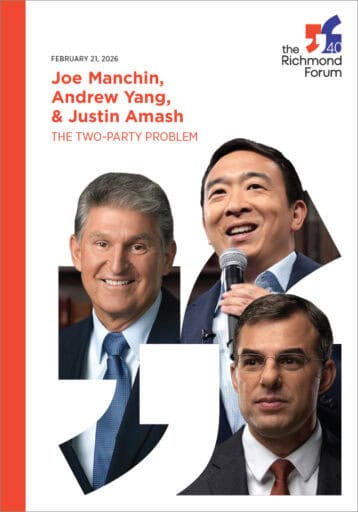
Joe Manchin, Andrew Yang, & Justin Amash
The Two-Party Problem
We rethought the future of America’s two-party system with a trio of voices disrupting the red-versus-blue paradigm.
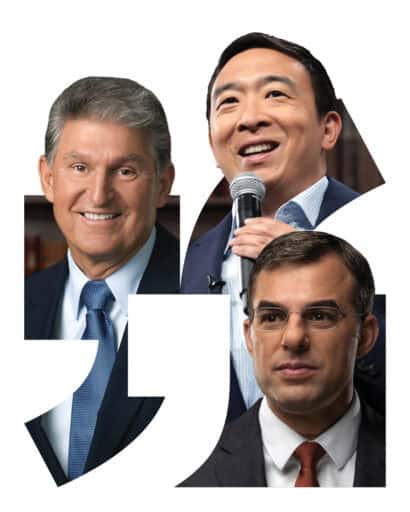

“The party system has been weaponized. It’s a duopoly — big business, billions and billions of dollars — and it makes you pick a side. If you pick a side, they both have the same Modus operandi — the other side’s evil, they’re wrong, you hate them, you’ve got to defeat them — so you don’t have anywhere else to go. I said enough is enough and I became an Independent.”
Sen. Joe Manchin
The Two-Party Problem
February 21, 2026
The two-party system is showing its cracks. As polarization deepens and trust in government erodes, many Americans are asking if the red-versus-blue framework can still fulfill the needs of a diverse and complicated society.
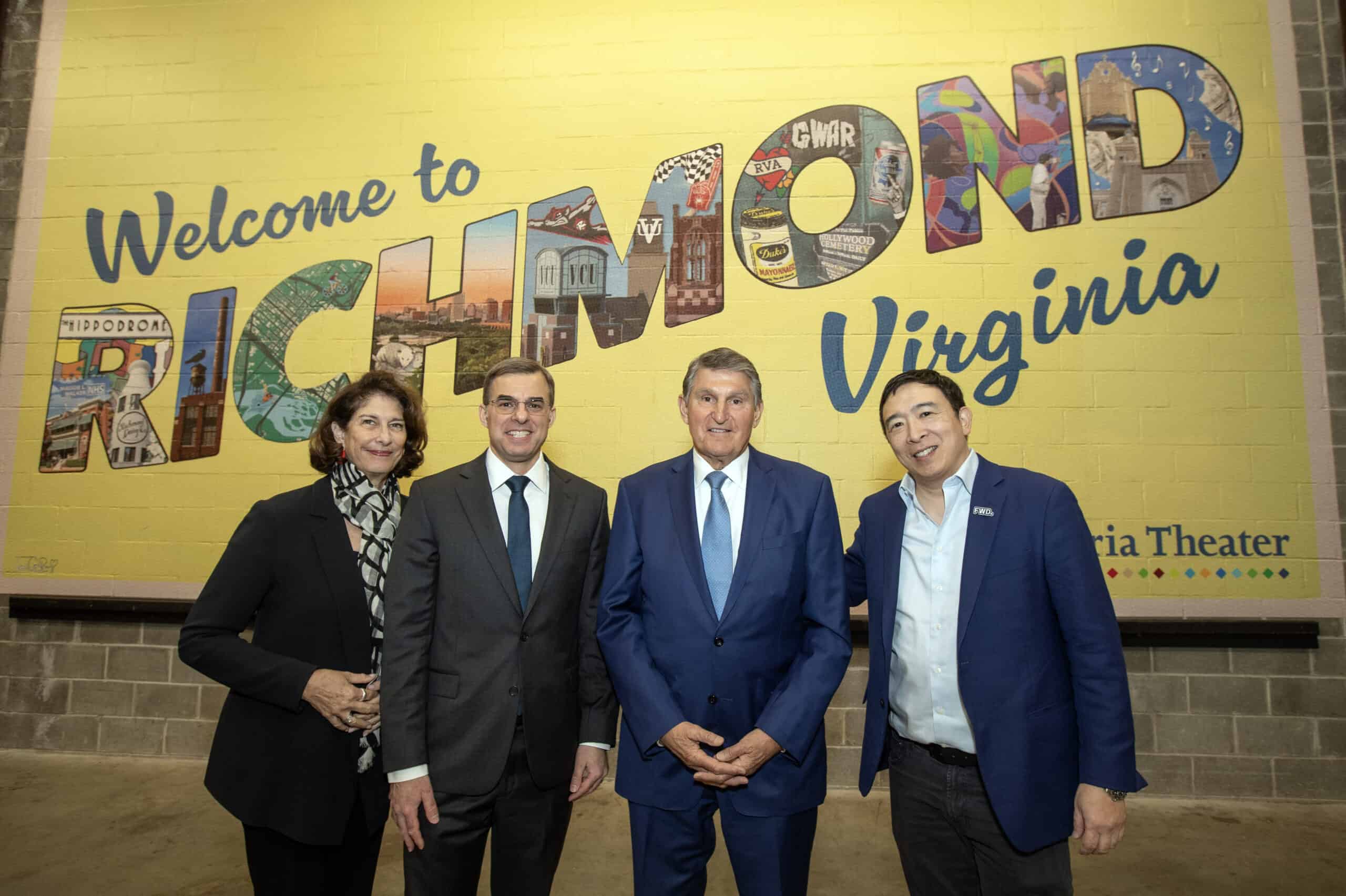
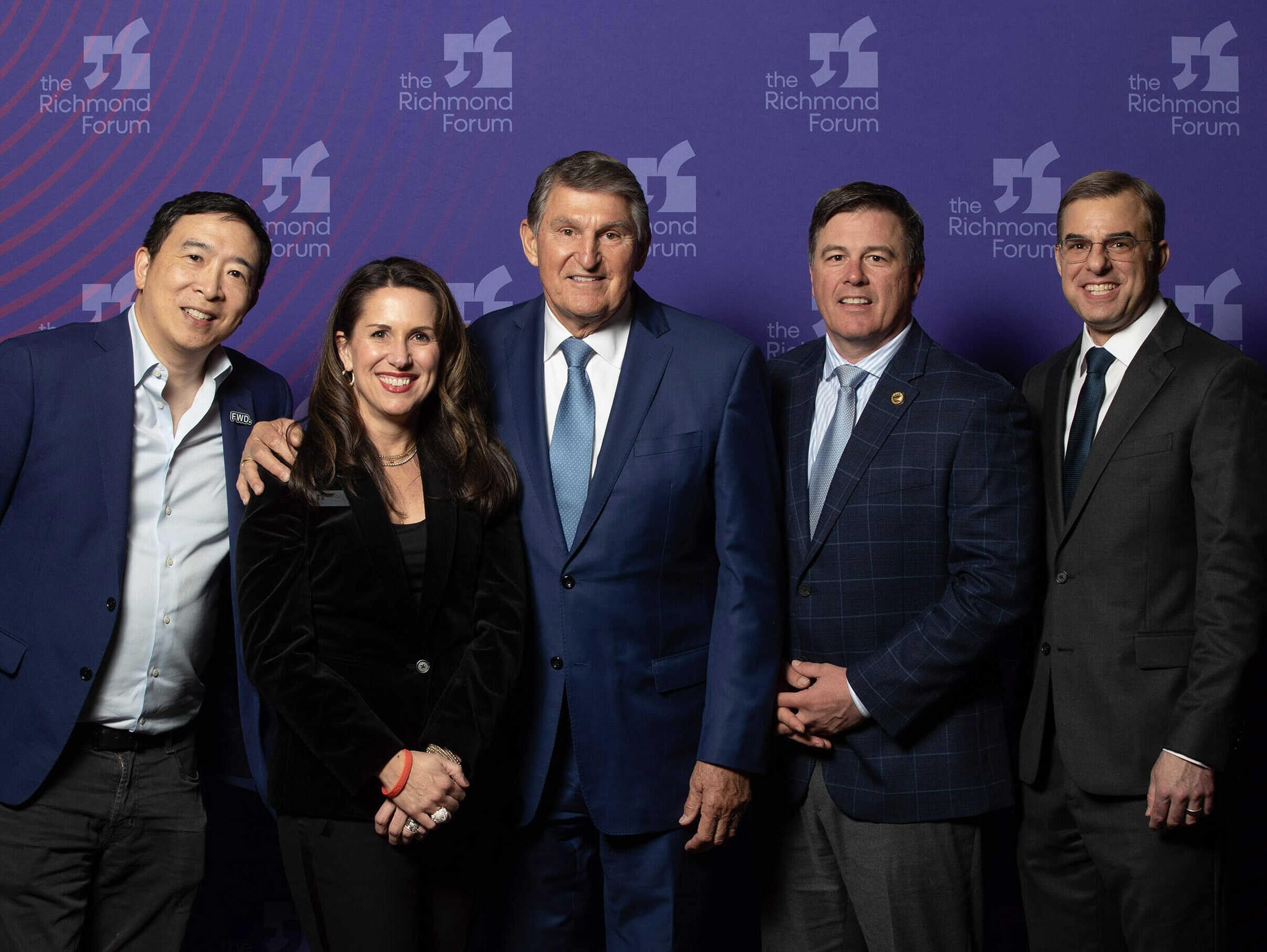
On Saturday, February 21, former Senator Joe Manchin, Forward Party co-founder Andrew Yang, and former Congressman Justin Amash examined how political tribalism stifles innovation and consensus. From alternative voting systems to the rise of independents, these three leaders explored whether a post-partisan future is possible and challenged the audience to rethink the foundations of American democracy in a time when the old rules are not working.
Moderator Mara Liasson opened the conversation by framing the stakes: a record-high 45% of Americans identify with neither major party. “This isn’t going to be a woe-is-me discussion,” she said. “We’re going to talk about solutions.”
Manchin, who formally left the Democratic Party to register as an independent, put it plainly. “The party system has been weaponized,” he said. “It’s a duopoly and it makes you pick a side. They both have the same modus operandi: the other side’s evil, they’re wrong, you hate them, you’ve got to defeat them. You don’t have anywhere else to go. I said enough is enough and I became an independent.”
“What’s happening now is what you would expect based upon the current design. The only way out is to change the design.”
– Andrew Yang
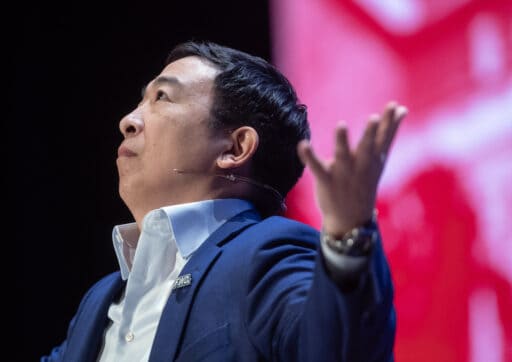
Yang, once a Democratic presidential candidate, traced the dysfunction to electoral mechanics. “The incentives are so lousy because of our primary system,” he said, noting that the small share (11%) of Americans who vote in primaries end up controlling who can get through the gate. With congressional approval near 15% but reelection rates around 94%, Yang said the mismatch would be unthinkable in business. “If four out of five of your customers were unhappy and you changed absolutely nothing year after year,” he said, “that company wouldn’t last very long.”
“What’s happening now is what you would expect based upon the current design,” Yang added. “The only way out is to change the design.”
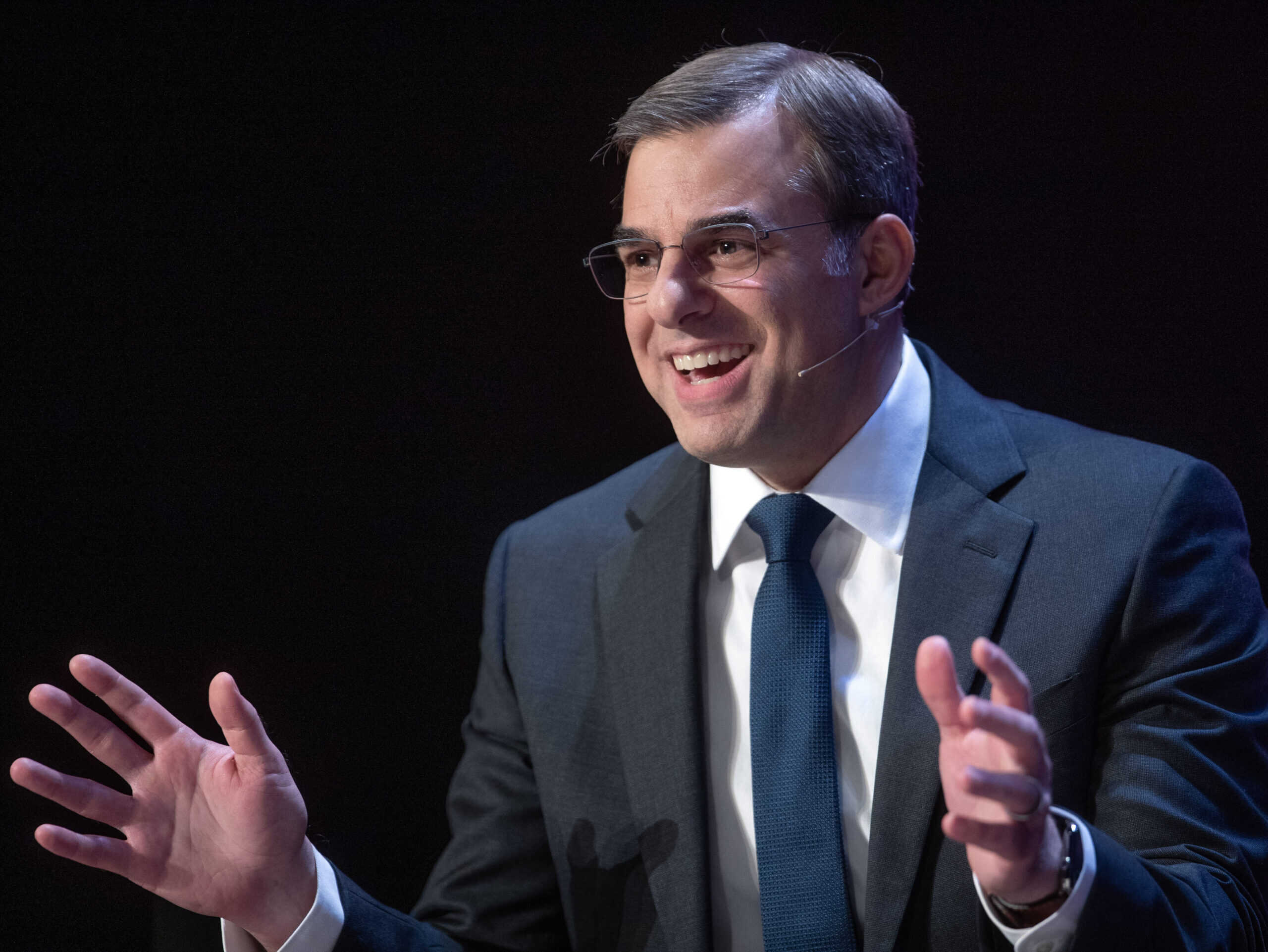
Amash, who left the Republican Party and later aligned with the Libertarian Party, described Congress as structurally oriented toward self-preservation. “Everything in Congress is for the sake of winning,” he said. “The entire system is structured to perpetuate power.” Party leadership, he added, controls committee assignments, legislative access, and campaign resources, leaving many lawmakers focused more on maintaining position than deliberating policy. The result, he warned, is “a partisan death spiral.”
When the discussion turned to remedies, consensus again emerged around structural reform. Yang advocated for ranked-choice voting (RCV), calling it a straightforward way to reward broader appeal. When Manchin quipped that they didn’t have enough time to explain how RCV works, Yang jokingly replied that if his young son can rank his favorite ice cream flavors, voters can handle a ranked ballot.
Manchin pushed for nonpartisan primaries and a specific set of term limits that includes a single six-year term for presidents and an 18-year limit on the Supreme Court. Amash focused on increased electoral competition, aligning Congressional election years to avoid perpetual campaigning, and empowering citizens to take back control. “It’s on you to shape Congress,” he said.
Liasson posed a question to the panel about younger generations’ increasing disillusionment with the “American Dream” and what can be done to address it. Yang was quick to validate their pessimism, citing data that shows those born in the 1990s have roughly a 50-50 chance of matching their parents’ standard of living. Manchin called for a national service requirement — one year for every 18-year-old — as a way to rebuild the civic identity that political reform ultimately depends on. Amash argued that people need to feel their participation matters.
In their closing reflections, the panelists reached back to the nation’s founding principles. Manchin invoked the framers’ vision of a government meant to answer to its people. Yang reminded the audience that Lincoln was a third-party candidate at the time, correcting the assumption that the current arrangement is inevitable. And Amash ended with Washington’s warning about concentrating too much power in the executive.
Together, they shared the conclusion that the American system is not irreparably broken, it is simply operating as designed. Whether it evolves, they suggested, depends less on Washington than on whether voters decide they want something different.
Continuing the Conversation
If the system is “working as designed,” as the speakers suggest, is the real problem the rules of American politics — or the political culture that operates within them?
With 45% of Americans identifying as independent, why hasn’t that translated into more independent candidates winning office? Is the barrier institutional, psychological, or both?
Amash said reform requires “competition.” What would meaningful political competition actually look like in practice — more parties, new voting systems, or something else?
How much responsibility does the decline of local journalism bear for national polarization, like Yang said? Can rebuilding local news realistically reduce partisan division?
Of the reforms discussed — ranked-choice voting, nonpartisan primaries, term limits, expanding the House — which seems most likely to improve governance quickly, and why?
Amash argued reform won’t come from Washington but from voters. What does meaningful civic engagement actually require from ordinary citizens today?



About Sen. Joe Manchin
Former Senator Joe Manchin represented West Virginia in the U.S. Senate from 2010 to 2025, where he was known for his independent streak and commitment to bipartisan cooperation. He served as chairman of the Senate Energy and Natural Resources Committee and was also a member of the Appropriations, Armed Services, and Veterans’ Affairs committees.
Born and raised in the small coal mining town of Farmington, West Virginia, Manchin was shaped by his community’s values of family, fairness, common sense, and hard work. His grandfather, known as “Papa Joe,” was an Italian immigrant and the town grocer who modeled entrepreneurship and the importance of serving the public. His grandmother, “Mama Kay,” inspired his lifelong commitment to public service through her deep compassion and care for those in need. These early influences laid the foundation for his “retail government” philosophy—prioritizing personal connection with constituents and responsive leadership.
Before joining the Senate, Manchin served in the West Virginia House of Delegates and Senate, as Secretary of State, and as Governor from 2005 to 2010. A centrist Democrat who later registered as an independent, he prioritized job creation, fiscal responsibility, and a balanced energy strategy that included both traditional and renewable resources.
Throughout his Senate tenure, Manchin played a pivotal role in key legislative negotiations, often acting as a swing vote. He championed efforts to protect Social Security and Medicare, reduce the national debt, and secure benefits for veterans.
An avid outdoorsman and licensed pilot, Manchin is married to Gayle Conelly Manchin, former federal co-chair of the Appalachian Regional Commission. They have three children and ten grandchildren.
About Andrew Yang
Andrew Yang is an entrepreneur, author, and political reform advocate whose career has spanned the private, nonprofit, and political sectors. He is best known for his 2020 presidential campaign and for co-founding the Forward Party, a centrist political movement launched in 2022.
Born in Schenectady, New York, Yang was raised in Westchester County. His parents immigrated from Taiwan as graduate students at the University of California, Berkeley. He graduated from Phillips Exeter Academy, earned a degree in political science and economics from Brown University, and received a law degree from Columbia University.
Yang began his career in startups before becoming CEO of Manhattan Prep, a test preparation company. In 2011, he founded the nonprofit organization Venture for America, which aimed to foster entrepreneurship in struggling cities. In 2015, the Obama administration named him a “Presidential Ambassador for Global Entrepreneurship.”
In 2020, Yang ran for president as a Democrat with the slogan “Make America Think Harder” (MATH). His signature policy proposal was universal basic income—a monthly payment to every American adult in response to economic disruptions caused by automation and artificial intelligence. Although he ended his campaign in early 2020, he built a dedicated digital following known as the “Yang Gang.”
In 2021, Yang left the Democratic Party and registered as an independent. The following year, he joined former Democrats, Republicans, and independents to form the Forward Party, focused on electoral reform, ranked-choice voting, and promoting a more collaborative political culture.
Yang is the author of three books: “Smart People Should Build Things (2014),” “The War on Normal People (2018),” and “Hey Yang, Where’s My Thousand Bucks? (2026).”
About Rep. Justin Amash
Justin Amash is a constitutional conservative and libertarian who served in the U.S. House of Representatives from 2011 to 2021. Representing Michigan’s 3rd Congressional District, he was known for his principled stance on individual liberty, economic freedom, and the rule of law. Over the course of his five terms, Amash developed a reputation for independence, transparency, and a consistent constitutional approach to legislation.
Born and raised in Grand Rapids, Michigan, Amash is the son of Palestinian and Syrian immigrants. He graduated from Grand Rapids Christian High School and earned a bachelor’s degree with high honors in economics from the University of Michigan. He went on to receive a juris doctor from the University of Michigan Law School before returning to West Michigan to practice law and work in his family’s business.
Before being elected to Congress in 2010, Amash served one term in the Michigan House of Representatives. In Congress, he became a leading voice on civil liberties, opposing warrantless surveillance, indefinite detention, and civil asset forfeiture. He was also a critic of corporate welfare, government overreach, and excessive spending.
In 2019, Amash left the Republican Party and became the first and only Libertarian member of Congress. He briefly explored a presidential run in 2020 and has continued to advocate for political reform, transparency, and constitutional governance.
Amash lives in Cascade Charter Township, Michigan, with his wife, Kara, and their three children: Alexander, Anwen, and Evelyn. He remains active in public discourse, promoting a vision of government rooted in accountability, individual rights, and nonpartisan integrity.