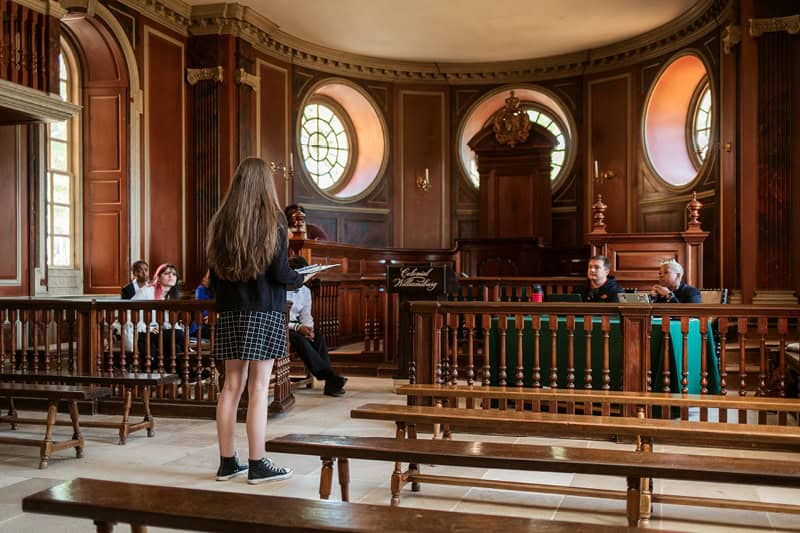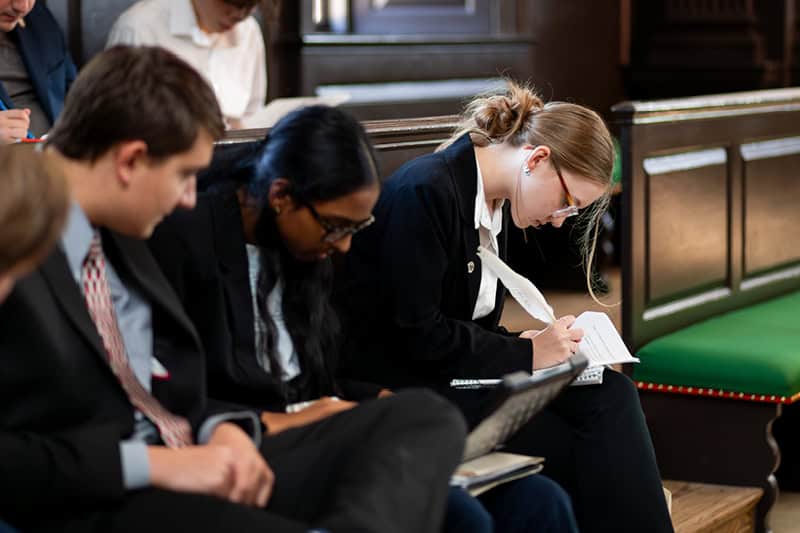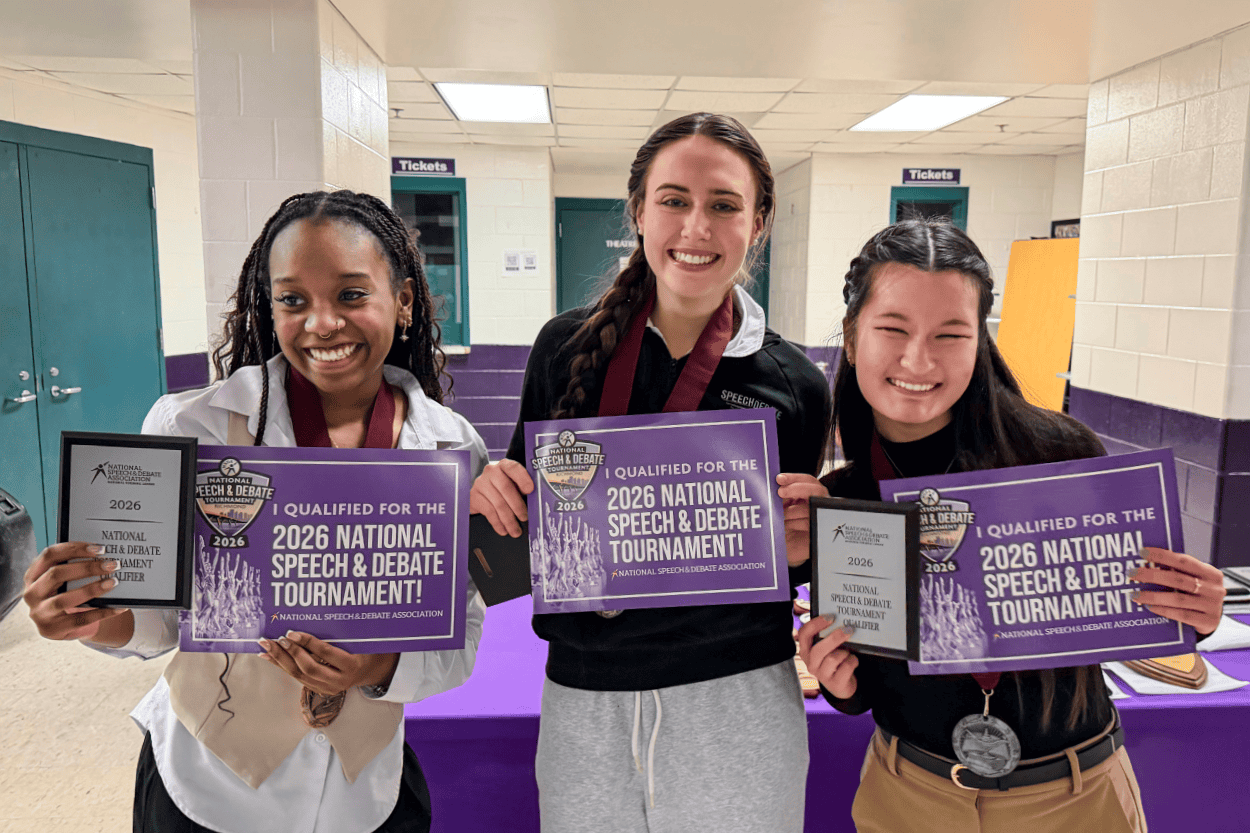
This summer, the National Speech & Debate Tournament comes to Richmond, shining a light on the local students who have qualified to compete.
In June, Richmond will host the National Speech & Debate Tournament, the largest academic competition in the world. More than 7,000 student competitors from roughly 1,500 schools across all 50 states will fill convention halls, school classrooms, and historic theaters across the region. Sixteen of those competitors will be from right here in Virginia’s capital.
The Qualifiers
Clover Hill High School (Coaches: Hunter Clark, Ethan Clark)
- Jasmine Franco, Lincoln-Douglas Debate
- Lydia Joh, Congressional Debate – House
Collegiate School (Coaches: Shannon Castelo, Laurel Maughan)
- Hollyn Borich, Program Oral Interpretation
- Emmett Lareau, International Extemporaneous Speaking
Cosby High School (Coaches: Jaclyn Clark, Scott McKeag, William Waddell)
- Connor Preciado, Congressional Debate – House
- Abigail Willis, Original Oratory
Deep Run High School (Coach: Sheryl Gibson)
- Isabella Paperman, Duo Interpretation (with Anna Weitzenhofer)
- Shelly Purser, Program Oral Interpretation
- Anna Weitzenhofer, Duo Interpretation (with Isabella Paperman)
James River High School (Coaches: Jessica Sanchez, Joey Tucker)
- Naomi Fife, Humorous Interpretation
- Evelyn Gayle, Informative Speaking
- Malcolm Hess, United States Extemporaneous Speaking
LC Bird High School (Coach: Melissa Ligh)
- Krishelle Belcher, Dramatic Interpretation
Maggie Walker Governor’s School (Coaches: Cecilia Boswell, Erin MacPherson)
- Vrinda Shah, International Extemporaneous Speaking
Monacan High School (Coaches: Sanchez Tucker, Olivia Boisseau, Joey Tucker)
- Ava Cordovana, Duo Interpretation (with Elise Mackey)
- Elise Mackey, Duo Interpretation (with Ava Cordovana)
Their Stories
“You Are Your Biggest Competitor”
Jasmine Franco describes herself as timid by nature. She moved frequently as a child, and the constant relocations made it hard to build lasting friendships. Speech and debate changed that.
“Once I began doing speech and debate, I grew more confident in the way I spoke and was able to more efficiently communicate my ideas,” Franco said. “I also found a community of like-minded people that translated across states. In every new city we moved to, I was able to find people who had similar interests and mindsets.”
Franco competes in Lincoln-Douglas Debate, a one-on-one format centered on values-based argumentation.
“Qualifying for Nationals was something I never saw in the cards for myself,” she said. “There is power in not counting yourself out. You truly don’t know what you’re capable of until you put yourself out there and try.”
A New Team, a Silly Piece, a National Stage
When Monacan High School restarted its speech program in 2024, after a quarter-century hiatus, Elise Mackey joined to support a friend who was building the team. She did not have high expectations.
In her sophomore year, Mackey had to quit competitive swimming after an illness, and she was not cast in her school’s play. She decided it was time to try something new.
“Speech opened a whole new world to me,” Mackey said. “It helped me grow as a competitor, a performer, and a friend. Very rarely do you find a sport where everyone is rooting for one another so avidly.”
This year, Mackey and her best friend, Ava Cordovana, entered Duo Interpretation together.
“Ava and I joke and mess around all the time, so we decided to channel that energy into Duo,” Mackey said. “We found a silly piece and were able to pretty much just be ourselves. Making it to Nationals was a huge surprise.”
Cordovana, who had stepped away from theater before high school, said the event helped her recover something she had lost. “I realized that I had suppressed a key part of myself,” she said. “I got to discover that I can be a good speaker and presenter, but I should never let go of the silly side.”
Three Years Running
Evelyn Gayle of James River High School has qualified for the national tournament three consecutive years in Informative Speaking.
“Over my three years as a competitor, I’ve learned skills that pertain to community, collaboration, and persuasion,” she said. “NSDA Nationals is an amazing opportunity to meet new people from across the country. Whether you win or lose, the memories you make at every tournament outweigh the medals you may win.”
Her coach, Jessica Sanchez, has built the James River program into one of the region’s strongest. She describes coaching as both a craft and a calling.
“Coaching speech is a science,” Sanchez said. “You have to teach students beats and pauses. You have to teach them how to tone down the excitement in one point and bring it back in another.”
The reward, she said, goes beyond technique. “Speech and debate changes lives. It opens doors. It opens pathways. To help a child find their voice is everything. I get to see these kids come alive and figure out who they are.”
Real-World Application
Abigail Willis of Cosby High School chose to write her Original Oratory piece around the protection of public media. The event requires students to research, write, and deliver a persuasive speech entirely of their own construction.
“Public media is essential to a free and equitable education,” Willis said. “Limiting public information sources is a threat to our nation’s democracy.”
Her teammate Connor Preciado, team captain and Congressional Debate qualifier, joined the activity because of its subject matter. Congressional Debate requires students to argue actual policy legislation in a simulated legislative chamber.
“I love debating solutions to our nation’s biggest problems,” Preciado said. “One moment we are speaking about Iran, then speaking about Medicare for all the next. I feel as if we are really talking about things that can make an important effect in Americans’ lives.”
When the Richmond Forum Speech & Debate Initiative (RFSDI) launched in 2018 with 10 high school teams, no students from the region qualified for nationals, and total annual participation stood at 171. Today, 43 schools have active teams, including middle schools, and participation has grown to nearly 1,000 students.
For the 16 local students who qualified, this is a huge personal and academic achievement. It is the result of months and years of preparation, the guidance of coaches who stayed late and pushed hard, and a decision made to try something that required them to stand up and speak.
We are so proud of these students and the 900 others who showed up to RFSDI tournaments, bright and early on a Saturday morning, ready to make their voices heard.