Inside Richmond’s Tradition of Public Discourse
Before The Richmond Forum filled the Altria Theater with conversation, Richmond was already a city where people came together to exchange ideas.
The Lyceum Movement
In the early 19th century, the city joined a national experiment in public learning known as the Lyceum movement: a wave of civic lecture series that swept across the country beginning in the 1820s. Named for the school in ancient Athens where Aristotle taught, the Lyceum movement encouraged citizens to gather outside the classroom to explore science, philosophy, and politics together.
Richmond’s own Lyceum, active by 1831, met in halls near Capitol Square and on the roof of the Jefferson Hotel, inviting “ladies and gentlemen of intelligence” to attend. Local newspapers advertised talks on subjects ranging from moral philosophy to the newest scientific discoveries. For a city still defining itself, these gatherings reflected a simple but powerful idea that knowledge should be shared publicly, and that dialogue could strengthen democracy.
By the mid-19th century, the Lyceum had helped forge a civic identity that valued eloquence, debate, and community engagement. That same impulse would later reappear in the form of public forums, modern heirs to the Lyceum’s belief that conversation could be both enlightening and unifying.
The Richmond Public Forum
In 1934, during the depths of the Great Depression, a new group of civic leaders brought the Lyceum concept back to life. The Richmond Public Forum began holding lectures at John Marshall High School, offering admission for just 25 cents per program. Its purpose was clear: to give Richmonders access to “the vital questions of the day.”
Audiences filled the auditorium to hear speakers discuss democracy, economics, education, and the rise of fascism abroad. The atmosphere was serious but optimistic, as the city came together to better understand a turbulent world. For more than two decades, the Public Forum thrived.
But by the 1950s, habits were changing. Television had entered nearly every home, offering nightly news and entertainment at no extra cost. The crowds thinned, and in 1955 the Richmond Public Forum quietly concluded its 21st and final season.
The Public Forum, Revived
The idea refused to disappear. In 1964, a group from the First Unitarian Church revived the Public Forum at the Mosque Theater (now the Altria Theater), determined to keep public discourse alive in Richmond. Over the next 16 years, the stage welcomed an extraordinary range of speakers, with Henry Kissinger, Shirley Chisholm, Ronald Reagan, and Moshe Dayan among them.
But by 1980, financial and organizational challenges again brought the series to a close. For the second time, Richmond’s long tradition of civic conversation fell silent.
The Richmond Forum
Five years later, in 1985, a small group of local businesspeople began urging Ralph F. Krueger Jr., an advertising executive and radio personality who helped lead the earlier Public Forum, to try again. They met every week at Aunt Sarah’s Pancake House on Midlothian Turnpike as a networking group that called itself the Oilmen’s Association.
Krueger was hesitant. He remembered the long hours and financial strain that had doomed earlier efforts, but the group persisted, offering both enthusiasm and structure. If he would lead, they said, they would form his first board of directors.
Together they began raising funds and recruiting support. The Retail Merchants Association provided the crucial first grant of $25,000, which later expanded to $125,000 annually, and Governor Gerald Baliles agreed to serve as honorary chair. With that foundation, the organization formally incorporated in 1986 as The Metropolitan Richmond Forum, soon renamed simply The Richmond Forum.
In a gesture of continuity, the remaining council members of the earlier Public Forum voted to transfer their assets, including cash reserves, lecterns, and even backdrops, to Krueger’s new enterprise. Richmond once again had a stage for ideas.
Opening Night
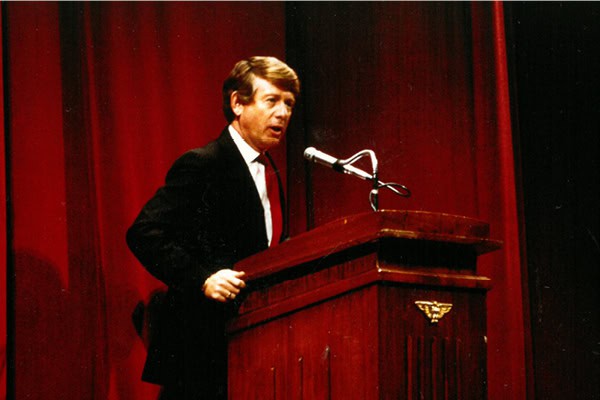
On January 24, 1987, after months of planning, the lights rose at the Mosque for The Forum’s inaugural program: “The News and the Newsmakers” with Ted Koppel.
Backstage was chaotic. Scripts were misplaced and microphones were misbehaving, but the program itself was electric. Koppel spoke about the “cult of cliché” in modern communication and warned that America’s “capacity for dialogue is becoming a faded memory.” For a city reviving its own tradition of public discourse, the message landed with special resonance.
The next morning’s headlines called the evening a triumph. Richmonders had rediscovered their appetite for conversation.
Koppel was followed by a panel with Hodding Carter, Paul Duke, and Larry Speakes discussing freedom of the press; Diane Sawyer dissecting the Iran-Contra affair with Brent Scowcroft (in a now-legendary incident involving a rogue microphone); and Charles Kuralt celebrating storytelling itself.
By season’s end, The Forum had drawn national coverage. Newspapers as far away as The New York Times and The Washington Post took note of Richmond’s new “intellectual destination.” More importantly, Richmonders took pride in it. “It feels like they’re sitting in your living room,” one attendee said. “There’s an exuberance and excitement you can’t get by turning on the TV.”
Governor Baliles, who had introduced The Forum to the public, saw it as more than a lecture series. “The Richmond Forum elevates the level of discussion throughout the community,” he said. “Even for those who don’t go, it has a ripple effect.”
A Lasting Legacy
By the 1990s, The Richmond Forum had become one of the nation’s premier speaker series, attracting global figures from Margaret Thatcher and Carl Sagan to Oprah Winfrey and Mikhail Gorbachev. Krueger’s motto, “Your Richmond Forum,” summed up his belief that the organization belonged to the community. After his passing in 1992, that spirit endured as new leaders carried his vision forward.
As The Richmond Forum celebrates its 40th season, it stands as the modern descendant of nearly two centuries of civic dialogue, from the Richmond Lyceum’s earnest lectures to the full houses of the Altria Theater.
Each era has had its own tools—chalkboards, microphones, cameras, livestreams—but the goal has remained the same: to create a space where knowledge is shared, opinions are tested, and understanding grows.
In every age, Richmond’s answer to the question of how a community learns has been the same: we gather, we listen, and we learn together.